Wednesday, April 22, 2009

Carnival PKIK 2009


On Sunday 19th April 2009, a fund raising activities held in Padang S.J.K. (C) Yu Hua which was organized by PKIK (Persatuan Kanak-Kanak Istimewa Kajang Selangor) which was attended by Malaysians from all walks of life depicting the coming together for a good caused of helping the special people. Jamie Sim who was one of the volunteers informed us about participating in the fund raising and immediately accepted on behalf of Kajang Buddhist Centre (KBC or BMSM - Buddhist Missionary Society of Malaysia Kajang Branch).

Extract from their flyers

What is PKIK (Persatuan Kanak-Kanak Istimewa Kajang Selangor)?
Is a welfare-based organisation serving the needs of children/persons with learning disabilities. It runs training programmes to help them in their overall development, learn independent living skills to enable them to lead as meaningful a life as possible. PKIK is dependent on donations from organisations and members of the public to help it run services for these people with special needs.

They are currently on a Building Fund Raising Drive to meet the cost of purchase of a piece of land and construction of its building complex.

They are currently serving 104 special clients in 5 shoplots. They are grateful and appreciative of your continous support and contributions. For Donations here are the particulars.

Persatuan Kanak-Kanak Istimewa Kajang Selangor
Add: No. 17, Jalan Seksyen 2/14, Taman Kajang Utama.
43000 Kajang. Selangor
Tel: +603-8736 6385
Fax: +603-8733 5012
Email : pkik@myjaring.net

Contact Person: Chairman Mr. Augustine Benedict
Secretary Kong Lan Lee.


The carnival started at 11.00 am and ended at 4.00 pm. Needless to say the crowd came in much earlier as everyone wanted their favorite dish. There are all kinds of food served here ranging from Sarawak Mee to Portugese Food (Malacca). Almost any kind of local food you can think of is here. And there is one particular item that caught my attention is the Vietnamese Popiah.

The weather was very unforgiving but everyone spirits were high expecting good sales as every sale is 100% contribution to PKIK fund raising.

Later it rain heavily and luckily it was towards 4.00pm and most of the stores had sold out and started packing. If you would like to donate to a good cause contact the above PKIK and be bless with bountiful happiness.

Click on play below to view photos

Sunday, April 19, 2009

Broga Hill


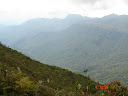
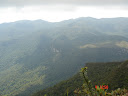
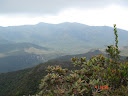
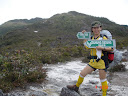
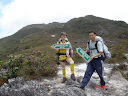
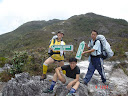
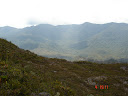
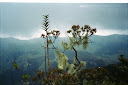
We first trek Broga Hill in the early 2000's and the trail was not well marked or clear but it was during a hash run that we cross over the Broga Hill top. And at that moment about 60 hashers just stop at the 1st Stop (Broga Hill shapes like the back of a camel) and enjoyed the panaromic scenery, Broga Town below towards East and Semenyih Town towards West. It was windy and everyone sort of just relax. Off course the Broga Town locals and orang asli frequent this place often.

It used to be popular for the locals and orang asli as this place has many wild board hideouts, so they would come out here to hunt or trap them and on the fringe of this hill (secondary forest) many wild boar traps are laid. I have personally come across a few while trekking there. Usually a shallow hole is dug, then a steel snarl or loop trap is laid in the hole and covered (camouflage) with twigs, the steel wire is then tired to a strong bended branch or strong shaft. When bended and once trip or released it has a powerful springing action. Once the wild board steps into the trap it triggers the trap snarling one of its leg. Once in while you might find other kinds of wild animals trapped.

As people are aware of the benefits of exercise especially with nature (i personally don't like to exercise within four walls) Broga Hill has become a popular trek on weekends as seen by the number of cars park from inside the oil palm estate (private land). The owner so far have not complain publicly, good for us. So in return it is hope that every visitor keeps the place clean.

"Take nothing but photographs!. Leave nothing but footsteps!"

There are 2 standard trails, if you a 'first timer' here, come on Sundays (before 6.45am) there will a regular group headed by Mr. Szeto, a middle age chinese trekker. He will be happy to show you the way. Normally he takes the back route going on the right through oil palm estate and then slowly snaking to the top through rubber estate route. For the normally fit this will take about 35 to 45 mins. And at the top along a ridge towards the left another 5 mins and viola! into a open area onto a big boulder to view the left side (Broga Town) and right side (Nottingham University Campus view ). From here onwards there are many view points for photography. The other route is on the left and straight up to Broga Hill view point 1, 2 and 3. This takes about 25 to 35 mins (normally fit). This other route especially if you need to view sunrise the trek should start around 5.30 am and only on clear skies.

After your climb there a few things you can do. Visit the rabbit farm just on the opposite side. Visit Broga Town for local breakfast at the coffee shop. Visit the Broga Rock Temple (Sek Dato). Visit Happy Fruit Land Farm. Well take your pick. Durian season is around May to July. There are many varieties from the numbered one to the Jungle types. Broga Town is a closely knitted community of around 500 families. Life here is what you expect of a small town, practically everyone knows everyone and a nice place to relax.

Click on the play button to view a slide show of Broga Hill


email ykkclow@gmail.com

Monday, March 30, 2009

YO-YO, Champion from Kajang

Did you know that in Kajang we have have a homegrown yo-yo champion? I guess not. In 1973 there were yo-yo competitions promoted and sponsored by Coca-Cola company. It became a instant hit and it was the toy to get. The hours we spent practicing the tricks and loops till our fingers became blistered and sometimes black eyed, especially attempting the trick 'shoot the moon'.


My childhood friend and neighbor Robert Low (click to know about his Fried Hockkien Mee), started yo-yoing (our English term for playing yo-yo) when he was 12 years old. We entered many competitions in Kajang, KL and PJ, together we have won many district and weekend challengers. Well actually Robert won more than I did and our prize included crates of Coca-Cola drinks, yo-yo s', strings and others. Robert almost made it to the finals which was held at the Coca-Cola factory in Sungai Besi, Kuala Lumpur and the first prize was a brand new car and won by a Eurasian guy. Robert could remember the Judge, Mr. Alfanso Trujilo from Colombia, in the finals whoever can play the most number of loops (loop-a-loop) will be the champion.

In 1975, the yo-yo promotion was back in Malaysia and this time Robert at age 14 more experienced and could play very well in loop-a-loop with both hands. Still miss the finals but he was spotted doing the loops with both hands (a trick considered difficult) by a Philippine yo-yo champion. Robert was invited to be one of the professionals of the Russell YO-YO team conductiong promotions.

In Roberts' words:-

"I started traveling with the Russell YO-YO team in 1981 to countries that include Colombia, Brazil, Spain, Singapore, China, Hong Kong, Jordan and Panama. While I yo-yoing around I started collecting yo-yos from all over the world. I'm still having my first yo-yo I bought at RM 1.70 (USD 0.45) in 1973. 2 yo-yos from the year 1969 in Colombia. I have traded about 20 yo-yos with Mr. Yohan (USA Champion). Now in my collection there are more than 800 pieces of yo-yo from around the world and I'm willing to trade some of my yo-yos"


Click On The Above To View Slide Of Yo-Yo Collections


Robert Low can be contacted at
kid_mon@hotmail.com. Robert also has a team of yo-yo players also known as R-YO Team that does commercial promotions at company functions and competitions for companies promoting their products. You can also view his collections at his Felicidad Restaurant in Kajang.


Sunday, March 1, 2009

St John Ambulance Malaysia, Pictures From The Past

The Following Paragraph Was Extracted From The St John Ambulance of Malaysia Web Site.

The St. John Ambulance Association (SJAA) was the first Foundation of the Order of St. John to be established in the then Malaya in 1908 at Kuala Lumpur. At that time, the SJAA Committee and members consisted of the British Civil servants and medical officers from the British Army stationed in Malaya and Singapore. In 1938, Lady Ursula Copland-Griffiths, Superintendent-in-Chief of the St. John Ambulance Brigade came to Malaya on an assignment to organise the formation of the St. John Ambulance Brigade (SJAB) in the States of Malaya. Following this initiative in the same year, St. John Ambulance Brigade Divisions were formed in the major towns in Perak, Penang as well as in Kuala Lumpur and Johore Bahru. From 1938 to 1940, the British Administrations in each Malay State established the St. John Ambulance Brigade Divisions in schools, government establishments and in the Federated Malay States Railways.

Click on this link for a full Organisation History in Malaysia

The following are 'yesteryear' pictures from the St John Ambulance Hulu Langat, Kajang Branch. Most of the photographs were taken in the field (now Stadium Kajang) and in the background is the old Town Hall and RTM Kajang.


Sunday, June 22, 2008

Bukit Putih, Wangsa Cheras. "Ah Pak San"

Bazaar Sale Fund Raising Campaign

Bazaar Sale Fund Raising Campaign

The committees of Bukit Putih, Wangsa Cheras and Ti-Ratana Welfare Society of Malaysia had organised a bazaar sale fund raising campaign in aid of the Sze Chuan Earthquake (China) and Myanmar Cyclone Nargis. The bazaar sale was held at the open air car entrance to the Bukit Putih or popularly known as "Ah Pak San". I have trek up this hill before and there are about 7 Stations (Level 1 to Level 7) and for the reasonable fit it will take about 45 - 60 minutes. The trails are well trek and mark with signs and directions so one can only loose their way if you trek away from the mark trail. Bukit Putih has hit the news a few time where adventurous trekkers trek away from the normal trail and had to stay overnight in the jungle. Luckily they came away unharmed but bruise, tired and lots of mosquitoes mark.

Bukit Putih, Wangsa Cheras (Ah Pak San) is popular for trekkers out to have a good workout and to enjoy fresh air just outside of Kuala Lumpur. On week days the crowd averages about 300 and up to a 1,000 on weekends and public holidays.

The signboard above says entry is forbidden without permission and trespassers are liable to a maximum fine of $10,000 or 3 years jail or both. I believe common good sense prevail that the Forestry Department of Selangor has not enforce this rule. The Bukit Putih, Wangsa Cheras committee has placed many signboards especially to parking, cleanliness and advising visitors to respect the residents living around the entrance trekking up to Bukit Putih (Ah Pak San).

Venerable Chief K. Dhamaratana, YB Tan Kok Wai MP Cheras

Guest of Honor: Ven K Sri Dhamaratana Nayakha Maha Thera, Chief Buddhist Monk of Malaysia and YB Tan Kok Wai Member of Parliament, Cheras.

Guest of Honor YB Teo Nie Ching Member of Parliament, Serdang.

The funds raise were every bit satisfactory to everyone who had contributed towards a good cause. By noon most of the food stuffs were sold off which shows how generous visitors to Bukit Putih.

To view more photos click PLAY below.

Tuesday, April 29, 2008

The Great Kajang Flood 70's

On the morning of the Great Floods that happen in Kajang. Morgan Soo who reside in Kajang Town started taking photos of various places in Kajang Town. See if you can identify the various places.


Picture 1
Beside TNB Kajang


Picture 2
Jalan Mendaling - the Last Shop on left is "Sea Yea" Temple


Picture 3

This is the Jalan Sungai Chua outside the shop houses from Kajang Garden which has changed to Desa Bunga Raya. The new flyover is standing over this location.


Picture 4
Kg. Jambu, next to the Langat River is the first to be flooded.


Picture 5
"Sea Yea" Temple side view


Picture 6
Kg. Jambu, Sikh Temple beside the railway gate.


Picture 7

The railway bridge over Kajang river, those days its made of iron structure but now replace with concrete. Its location just behind Aked Mara building and TNB Kajang Jalan Reko.


Picture 8

The roundabout between Main Street and Suleiman Street, the old bazaar is on the right. Metro Plaza building is occupying this location.


Picture 9

LLN Kajang now TNB Kajang same location beside Aked Mara building


Picture 10

Railway bridge over Kajang River. Notice the bended railway line cause by the floods.


Picture 11
Kg. Jambu


Picture 12
Railway track towards Kuala Lumpur direction, Kg. Jambu should be on the right and Sg. Chua on the left.


Picture 13
Photo taken from the railway bridge, River View Garden opposite of the "Sea Yea" Temple (back of Jalan Mendaling).


Picture 14


Kajang Roundabout with the National Cinema at the rear. On the left is Chiam Kee Chicken Rice Shop which has moved to Medan Selera (beside Kajang Market). If you are turning from the back of Bank Islam as you approach the Kajang Market there is a bridge on the right and the right has an eatery shop is now the present Chiam Kee Chicken Rice Shop.


Picture 15


The old Kajang Market I believe the present location is the Aked Mara building.


Picture 16

Shell Station just in front of Foh Hup Bus Station (ceased operations) now occupy by Metro Plaza Kajang. This Shell Station has moved to Jalan Semenyih just in front Kajang High School (KHS school field)


Picture 17
Side view of Sin Swee Kee Motor Shop and on the right is MCA office (undergoing construction now)


Picture 18
Side view of "Sea Yea" Temple, the flooded front portion is now the Hockkien Temple.


Picture 19
The former IC department office location.


Picture 20


I believe the railway line between Sungai Chua and the Railway bridge.


The above photos is courtesy of Morgan Soo. If you have any idea on the above (Pictures 1-20) locations please post your comment. Meanwhile Morgan Soo will be providing the actual details and location. Well if you can remember the exact location please let us know.


Wednesday, April 16, 2008

Kajang Town

Text & Photography by: Mohd Nasir Abdul Rashid
email: puresein@gmail.com


Kajang Town started blooming from surrounding rubber estate. Kajang attracts colours of life and give this town its own life. After 200 years, there are a lot of things to come, to go and here to stay.


Lee Chang Long Shop at Jalan Besar, Jalan Tukang junction.

If there is a contemporary proverb to describe Kajang Town, I would like to recommend this: “If you come to the center of this town, open your car windows wide and smell the special aroma that has made Kajang famous and indulge on the exotic cuisine while enjoying the uniqueness of this 200 year old municipality.”

Kajang was first established in 1807 and mushroomed into a modern township as it enjoys the burgeoning rubber estate business at the turn of the 20th century. Nowadays, Kajang has prospered to be one the most developed sub-urban township of Klang Valley and have been linked with modern highways and complete network of transportations. Situated in the southern part of Selangor state of Hulu Langat district, it is inhabited by more than 230,000,000 residents of various races and religion.

Strolling around town in the morning, you can catch a breath of fresh air surplus of the lush green surrounding of the township with approximately 788 square kilometers wide. Considered to be the middle frontier town from the Selangor/Negeri Sembilan forest reserve to the east, Kajang’s proximity to the fast developing west side makes it more and more alluring and attracts tourists, new residents and investors.

To the east, the adjacent subdistrict of Hulu Semenyih provide an area for the biggest water catchment in Malaysia. Named as the Semenyih Reservoir, the 1500 acre man made lake offers a beautiful and breathtaking scenery with its blue turquoise water and bordering thick jungle.
From Semenyih Town taking the Jalan Kacau road you can rest at the famous Sungai Tekala waterfall and unwind while bathing in the cool natural mountain streams.

Thanks to the expansion of the Kuala Lumpur metropolis, Kajang offers a complete scope of life in terms of economic modernity and complete facility, while still embracing nature.


Kajang Town circa 60's


Kajang Old Town


The development of Kajang was first concentrated in Sungai Chua (Chua River) and since then, have also created residential and shop houses along roads leading out of Kajang Town beside the main Langat River. Along the main road of Jalan Semenyih, we can recognize the mixed combination of new and old buildings of the old Kajang. We still can see what’s left of the colonial era at the structures and designs of old shop houses along Jalan Sulaiman, Jalan Besar
and Jalan Mendaling

Most of the buildings in Kajang Old Town were constructed around 1920s to 1930s. The architecture of these shop houses is a combination of traditional Chinese and European design. The ground floor was used for commercial activities and the upper floor as living space for the family.

Hulu Langat Hokkien Association (formerly The Late Low Ti Kok's Mansion)


The interior of Hulu Langat Hokkien Association building.

One of the well known old building in Kajang is Hulu Langat Hokkien Association, formerly the residence of the late Low Ti Kok (a successful business tycoon and philanthropist). Located beside the gold domed Hulu Langat Jamek mosque at Jalan Timur.


Hulu Langat Jamek mosque, one of the famous historical landmarks.


Kajang Stadium


At Kajang Stadium where a lot of community-based activities are held and just beside this stadium, a two story building of Bangunan Datuk Nazir is the epicenter which Kajang has been famously known for. With a non-stop stream of locals and tourists frequenting the outlet, it is a national acknowledgment to relate Kajang to its ‘satay’ or ‘sate’ (pronounced sa-tay).


Grilling Satay at Haji Samuri's Restaurant

Satay

Kajang is famous for this exotic cuisine called 'satay'. Satay is simply marinated meat, skewered, and charcoal-grilled and served with peanut sauce. The most famous restaurant that serves satay is Haji Samuri Satay Kajang. Along the river bank behind the Town Hall and Bangunan Datuk Nazir there are many satay vendor to choose from.


Satay, an exotic cuisine that has made Kajang famous.


Haji Samuri himself have opened more than 20 branches of its restaurants nationwide and employs more than 800 employees. With the offering of various meats from chicken, beef, tripe, liver or fish, the price per stick would be around RM0.60. They also serve lamb at RM0.90 per stick, deer at RM1.30 per stick and rabbit at RM1.60 per stick.

A thick peanut sauce with separate chili to cater to different taste buds is served for you to indulge. A must have of course is the ‘nasi impit’ (compressed rice cubs) or 'ketupat' that goes so well with the sauce. This is 'must try' if you happen to come to Kajang.

Bountiful food offerings are scattered over the town with a wide variety to choose from. Either you are keen on Chinese or Indian food, Kajang offers a lot of specialized outlets for your taste. Famous fast food chains had been opened since decades ago while luxury Chinese restaurant can be found anywhere in Kajang. Whether you have the appetite for hotel-like dishes or food stall strung out of the road, Kajang has it all.

Coming to Kajang

Kajang is easily accessible from anywhere of its fringe area whether by car, train or public transport. Due to its closeness to Putrajaya, the Administrative Capital of Malaysia, Kajang is blessed with prosperity and development in all aspects of life.

Since the opening of North-South Expressway in 1982, Kajang is openly reachable from anywhere and after two more decades more modern highways were connected to this town and now Kajang is one the prime lands of the Klang Valley.

Hotels and a place to stay are abundant and if you want to stay at the nearby Putrajaya or Bangi, it has a couple of luxury accommodation such as Marriott Hotel in IOI Resort, Putrajaya, Shangri-la Putrajaya and Hotel Equatorial Bangi.

In Kajang itself, a four star Oriental Crystal Hotel with a rate around US$20-40 per night offers a very good bargain for a stay in this exceptional town. There are also Prescott Metro Inn, New City Hotel, Uptown Hotel and expect more hotels be developed to cater for the increasing demand.

Its a 15 minutes drive from Putrajaya and just around 40 minutes from the Kuala Lumpur International Airport (KLIA), if you’re staying in Pan Pacific KLIA or just watching the Formula One in Sepang International Circuit. The other convenient stay is the Palace of The Golden Horses in Seri Kembangan which can access Kajang through Cheras-Kajang Expressway in 20 minutes.

The New Kajang

Kajang nowadays has transform into a 'sub-city' on its own with unstoppable sprawling developments on its peripheral surrounding. A couple of new township has been developed to cater for more inhabitants from Kuala Lumpur such as Kajang Perdana and Prima Saujana, to name a few. Prima Saujana has its own golf course and at the Kajang exit from the North-South Highway, Kajang Country Heights, an upmarket residential estate greets you as you enter Kajang.

If you want to do golfing, Kajang Hill Golf Club or Prima Saujana Golf Club is ready to receive you at the very best of golf courses in Malaysia that landscape nature into its surrounding.

A new township has created more shopping convenience from Giant and Tesco hypermarkets to our own shopping complex such as Billion Shopping Center, Bintang Shopping Center, Metro Point and Metro Plaza to Ipoh Old Town and Coffee Bean. In short, Kajang is a booming town but in some sense, it still maintains its core of old times and historical memories that are here to stay.


One of the Chinese Temple in the town center.


Bountiful food offerings are scattered all over town with a wide variety to choose from.


Preparing ‘roti canai’ for breakfast.


A common view at Kajang train station.


Eating out for morning breakfast in Kajang.


Whatever it is, something will definitely stay for long and that would be the aroma of the grilled satay that lingers in the air at the town center, especially at the call of the evening. This is the usual time for locals and tourists to bring their family and friends to indulge in tourists favorite Satay cuisine.

I myself live in Kajang, and whenever I’m driving at early evenings near Haji Samuri’s, I will open my car windows wide and smell the special aroma of this 200 year old town.


An aerial view of Kajang from the highest peak of Bukit Mewah Club.


The usual morning on weekends.


Monday, January 14, 2008

Semenyih Curry Mee


On Sunday morning we decided to drive up to Semenyih town to eat Semenyih's curry mee. As I attended SJK (C) Sin Ming fund raising dinner in December I remember this curry mee coffee shop. It has been a while since I have been to this coffee shop which is situated just next to SJK (C) Sin Ming primary school in the heart of Semenyih old town.


During the fund raising dinner there were many performances and my niece was one of the ballet dances so here is the video of that ballet.


Upon arrival at this coffee shop I was surprised to find it over crowded and had to wait a while before a table was available and even after sitting down and placing our order for the usual Malaysian hot drink which is either tea or coffee and was informed to wait a while before we could place our order for the curry mee. A full 15 minutes before we could place our order which is curry bee hoon and mee (mix) and a barbecue chicken wing which I noticed every table having it. So Sunday is really a crowded day to come.

Finally our Semenyih curry mee arrived and we quickly finished it and the barbecue chicken wing tasted delicious. The curry mee is not that spicy and if you want to make more tasty just add the chili paste into the curry and mix it well. I find that it taste better that way.


Sunday, January 6, 2008

Broga Happy Fruit Land Camping


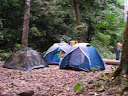
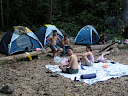
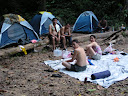
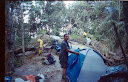
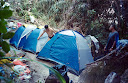
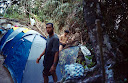
In December 07, our regular group that exercise regularly doing hill climbs around Broga Happy Fruit Land, as we were having our dinner and suddenly we had this idea about camping at Broga Happy Fruit Land to celebrate the new year 2008 by having a count down at Broga Happy Fruit Land. Most of our friends and their children have never gone camping unlike myself who does it regularly a few times a year.
Visit malaysiatrekking.blogspot.com

I was thinking that camping at Broga Happy Fruit Land was safe and convenient as water and electricity was available. And to make it more interesting we decided to have barbecue for the countdown. As preparations were being made with our three chef (Alice, Ah Chu and KC) on food for dinner, barbecue and breakfast. Our plan was to meet at Broga Happy Fruit Land on the eve 31st Dec 2007 around 3.00 pm, set up the tents and start climbing Broga Hill at 5.00 pm, with all the food planned its a good idea to burn if off climbing Broga Hill.

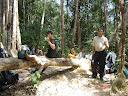
As regular hill climbers here for the last 4 years, I have set the trail namely two well trek trails, one at Broga Rock Temple and the other at Broga Happy Fruit Land. As more people come to join us some will do their climb at Broga Rock Temple and some at Broga Happy Fruit Land. Both are averaging 1 to 1.5 hours to climb for the young and old. Our youngest friend is around 6 years and the oldest my mom at 70. So anybody (unless with severe health problem) can follow this trail. One of the main attractions climbing is that the air here is fresh and clean as compare to parks near the city area where once I did light training in preparation for Gunung Tahan climb and later in the night my throat felt congested probably from the polluted air. If you have plans to go camping (3 to 7 nights) and need some good training areas why not try Broga hills. Word got out to other friends that we were organising a camping countdown and a family affair and our group swell to about 35 participants, about 6 left as they plan to stay until 1.00am 2008.

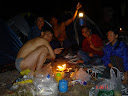
To entertain ourselves we sang karaoke songs throughout the night and for those who dislike our singing entertain themselves with stories and jokes and barbecue and as for children they really had a good time with the barbecue and playing around the tents. There was a light shower which actually cool down the area making it chilly, just nice for us.

As the hour tick closer to New Year 2008 we began noting the time and by then everyone's belly was bloated with food (over indulging) and plan for another climb early next morning (of course next morning everyone was too lazy to get up). Fifteen seconds left, turn up the radio 5..4..3..2..1.. Happy New Year 2008!!! and instead of playing and singing Auld Lang Syne we played Chinese New Year songs, nevertheless we just clap, dance and sing along having a good time. What a wonderful way to spend with family and friends to ushered into the New Year.

Finally to bed err.. I mean to 'sleeping mat' at around 2.30pm for some who have never experience camping find it hard to sleep until much later. As I lay down I was thinking 2008 what kind of resolutions do I want to set. Most people set resolutions every new year then again most people never achieve what they set. Thoughts went through my mind, about the impending price increase (consumable goods), election year, increase in expenses (children growing up) and schools reopens in a few days and more money to spend. So my resolution for 2008 is to be a good son, a better father, a better husband, a better friend and to increase my income (almost everyone wish for this) not that it will solve all problems but at least some of the financial ones. So......


HAPPY NEW YEAR 2008 to YOU!!!

and May You Have Fun, Happiness and Success!!!!

Thursday, December 6, 2007

Er Hu Chinese Violin, Chan Kum Loong

I visited a friend in Shah Alam and he invited us for dinner and mentioned that his Er Hu teacher (Mr. Chan Kum Loong) will be joining us and after that maybe play us a song or two. After a casual introduction we found out that he once taught Er Hu in SMJK Yu Hua Kajang. He spoke passionately about music and his Er Hu, we finished dinner and proceeded back to my friend house. He insisted that before he play his Er Hu he would like to hear KC sing a song which she obliged with a chinese number by Teresa Teng. And I requested that he allowed me to video him playing his Er Hu. Ah Loong as he is known, sometimes get invited along with some of his friends to perform usually for dinner functions such as birthday and etc.

I did a search on the internet and I found out that Er Hu has over a thousand year history. Er Hu is a kind of violin (fiddle) with two strings which, together with zhonghu, gaohu, sihu, etc, belongs to the "huqin" family. It is said that its origin dated back to the Tang dynasty (618-907) and related to the instrument, called xiqin originated from a Mongolian tribe Xi. During Song dynasty (960-1279), the second generation of the huqin was among the instruments played at the imperial banquets. During the Dynasties of Ming (1368-1644) and Qing (1644-1911), the Er Hu underwent a great development at the time of the golden age of the local operas. The Er Hu then developed into different "schools". Two famous artists Hua Yanjun (1893-1950) and Liu Tianhua (1895-1932) made an exceptional contribution to the improvement of the Er Hu, and it was indeed due to the latter that the erhu, an instrument mainly for accompaniment in an opera, became a solo instrument. After the formation of the People's Republic of China (1949), the production of the Er Hu, the playing techniques, the repertoire as well as the musical education of this instrument have undergone an unpresidented development. The repertoire has grown rapidly in the genres of solo, with ensemble as well as concerti with symphony orchestra. Er Hu now has become one of the most popular instruments in China.


Teresa Teng Song

The sound body of the Er Hu is a drum-like little case usually made of ebony or sandalwood and snake skins. It usually has a hexagonal shape with the length of approximately 13 cm. The front opening is covered with skin of python (snake) and that of the back is left open. The functions of this case of resonance are to amplify the vibrations of the strings. The neck of the Er Hu is about 81 cm long and is manufactured with the same materials as the drum. The top of the stem is bent for decoration. The two strings of the Er Hu is usually tuned D and A. The two tuning handles (pegs) are found close to the end of the stem. There is no frets (as contrast to the lute) or touching board (as contrast to violin). The player creates different pitches by touching the strings at various positions along the neck of the instrument. The strings are usually made of silk or nylon. Nowadays, metal strings are commonly used. The bow is 76 cm long and is manufactured of reed which one curves during cooking and arched with horse hair in the same way as the bow of violin. However, in the case of Er Hu, the horse's hair runs between the two strings. One cannot take off the bow from the instrument unless one of the two strings is taken off or broken. (the above is extracted from www.philmultic.com)

I was amazed with the song played on the Er Hu and it felt as if some part of my body move along with the rhythm, well if you have the opportunity to listen live you will understand what I mean.


Teresa Teng Song